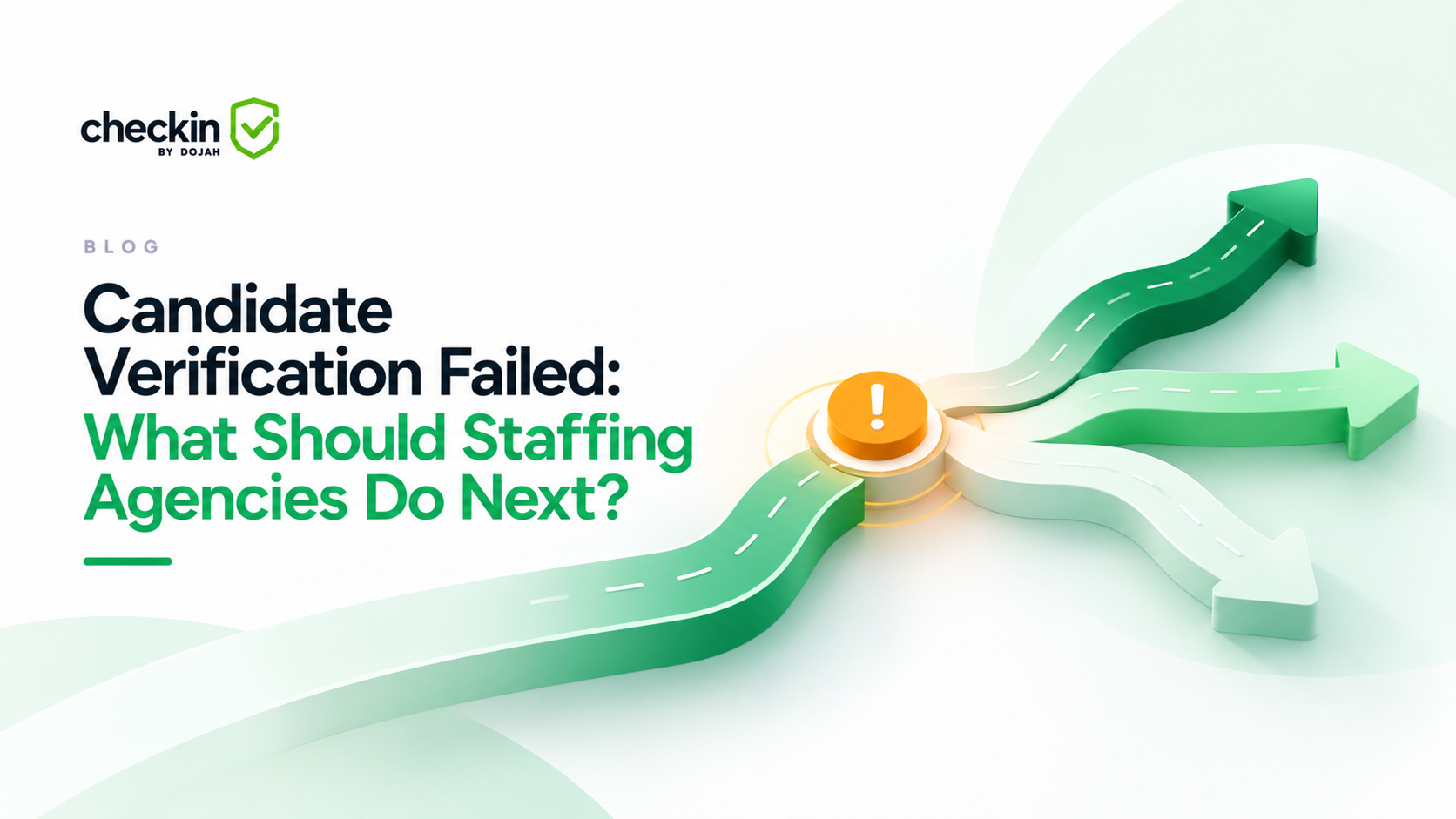
Candidate Verification Failed: What Should Staffing Agencies Do Next?
Candidate verification doesn't always go as planned. This guide explains why verification can fail, what recruiters should check next and when it makes sense to ask a candidate to try again.
Candidate Verification Failed: What Should Staffing Agencies Do Next?
A recruiter sends a candidate a verification link. The candidate completes the process, but instead of the result the recruiter expected, something has gone wrong.
Maybe the document couldn't be verified. Perhaps the candidate's details don't match, part of the identity check couldn't be completed, or the candidate simply stopped halfway through.
What happens next matters.
An unsuccessful verification shouldn't automatically be treated as fraud, but it shouldn't be ignored either. The recruiter needs to understand what went wrong, whether the candidate can correct it and when the issue needs further review.
This guide covers the common reasons candidate verification fails, what recruiters should do next and when it makes sense to ask a candidate to try again.
What Does a Failed Candidate Verification Mean?
A failed verification isn't one specific problem. There is a difference between a candidate who never completed the process, a document that couldn't be verified and information that doesn't match what was expected. Those situations shouldn't automatically lead to the same response.
Before deciding what happens to the candidate, start with three questions:
- Did the candidate complete the verification?
- Which check was unsuccessful or needs attention?
- Is the issue something the candidate can reasonably correct?
Those answers give the recruiter somewhere useful to start.
If you're looking for the process that comes before this point, our guide on how staffing agencies can verify candidate identity online explains how online candidate identity verification works from the beginning.
Common Reasons Candidate Verification Fails
- The Identity Document Could Not Be Verified: Sometimes the problem starts with the document submitted by the candidate. The photograph may be blurry, important information may be outside the frame or glare may make parts of the document difficult to read. In those situations, another attempt with a clearer image may resolve the problem.
But not every document issue is a photography problem. If the verification raises an issue with the document itself, repeatedly asking the candidate to upload the same document isn't necessarily going to change the outcome. The recruiter should first understand what the result is telling them and follow the agency's process for anything that needs further review. - The Candidate's Information Does Not Match: A mismatch deserves attention, but it also needs context. Perhaps the candidate entered something incorrectly. Maybe the information already held by the agency contains an error.
Or there may be a discrepancy that needs to be resolved before the candidate progresses. Instead of jumping straight from “mismatch” to “fraud,” establish what doesn't match. A typo and an unexplained identity discrepancy are not the same problem, so they shouldn't receive the same response. - The Identity Check Could Not Be Completed: Where the verification process includes additional identity checks, a candidate may be unable to complete one successfully. Before sending another verification request, find out whether there is something they can do differently. If there is, tell them.
A useful message might explain that they need to retake a photograph under better lighting or repeat a particular step. Simply sending the same link with “please try again” gives the candidate very little help and can leave the recruiter dealing with the same result twice. - The Candidate Didn't Finish: Not every unsuccessful verification actually failed. Sometimes the candidate opened the link, started the process and never completed it. They may have been interrupted, lost their connection or simply planned to return later.
That is why completion status matters. If nothing has actually failed, the appropriate next step may be a reminder rather than an escalation.
What Should Recruiters Do After a Failed Verification?
Once you know what happened, the response becomes much easier to structure.
Step 1: Check What Went Wrong
Don't respond to every unsuccessful verification in the same way.
Look at the specific result first. Was something incomplete? Was there a document problem? Did information fail to match? Does the result require someone on your team to review it?
The next step should respond to the actual issue.
Step 2: Decide Whether the Candidate Can Correct It
Some problems have straightforward fixes. An unclear photograph can be retaken. Incorrectly entered information may be corrected. An unfinished verification can be completed.
Other results may need review before another attempt is offered. Making that distinction prevents recruiters from repeatedly sending verification requests when a retry isn't the appropriate next step.
Step 3: Tell the Candidate What to Do Next
If another attempt is appropriate, don't make the candidate guess what needs to change. Give them a clear next action based on the information available to your team. That could mean taking a clearer photograph, checking the information they entered or completing a step they previously missed.
Good communication here is not just better for the candidate. It also reduces the chance that the recruiter will receive the same result again.
Step 4: Review Before the Candidate Progresses
If the issue remains unresolved, follow your agency's review or escalation process before moving the candidate forward.
This is particularly important when verification is required before a candidate can be presented to a client.
We've covered that stage separately in our guide on how to verify candidates before sending them to clients.
When Should a Candidate Be Asked to Verify Again?
A retry is useful when there is something the candidate can reasonably correct. A second attempt may make sense when:
- the document image wasn't clear enough;
- part of the document wasn't captured properly;
- the candidate entered information incorrectly;
- the verification was left incomplete; or
- the candidate received instructions that can help them correct the problem.
The important part is knowing why you're asking for another attempt.
If the same unexplained issue keeps appearing, the result requires further review, or there is an unresolved discrepancy, repeatedly restarting the verification may not be useful.
A simple rule for recruiters is:
Before asking a candidate to try again, know what you expect them to do differently. If you can not answer that, review the result first.
Don't Treat Every Failed Verification as Fraud
A failed identity check is a reason to investigate, not automatically a reason to accuse. Poor image quality, incomplete submissions and incorrect information can all interfere with verification without the candidate intentionally trying to deceive the agency.
At the same time, that doesn't mean discrepancies should be waved through. The recruiter needs to separate a correctable verification problem from a result that needs further investigation. This is one reason having a defined exception process matters.
Recruiters shouldn't have to make up the rules each time something goes wrong. Your agency should decide in advance:
- when another attempt can be offered;
- which results require review;
- who handles cases that cannot be resolved by the recruiter; and
- what needs to be resolved before the candidate can progress.
That creates a more consistent response for both recruiters and candidates.
How CheckIn Helps Teams Manage Candidate Verification
Verification isn't always a straight line from request to completion. Some candidates will complete their checks without a problem. Others will need attention along the way.
CheckIn gives staffing agencies a no-code way to create verification flows and send them to candidates through a simple link.
- Keep Verification Out of Recruiter Chats
Recruiters can continue using WhatsApp, email or SMS to communicate with candidates without using those conversations as the verification system itself.
The candidate follows the verification link and completes the required checks through the dedicated flow.
- Give Recruiters a Clearer Verification Process
When something needs attention, the recruiter shouldn't have to search through messages, downloaded documents and spreadsheet notes to work out what happened.
A structured verification process gives the team a clearer point from which to review the candidate's verification and decide what happens next.
- Build the Process Without Developer Dependency
Because CheckIn is no-code, staffing teams can build verification flows around the checks they need without having to develop their own verification system.
And if you're still deciding what your agency needs from a platform, our guide to candidate verification software for staffing agencies covers what to consider when evaluating one.
A candidate verification that doesn't go as expected doesn't have to bring the recruitment process to a standstill. The important thing is knowing what happened, what can be corrected and what needs further attention.
Build your candidate verification flow with CheckIn
Filed under